
AI-generated
WIP Comms Foundation


You’ve probably heard about SEO - maybe you’ve even used it to grow your business. But the search landscape in 2026 is shifting faster than most brands realize. With the rise of GEO (Generative Engine Optimization) and AIO (AI Optimization), traditional SEO alone isn’t enough to stay visible.
According to SEO experts in the AI era, AI search systems now summarize, cite, and synthesize content across the web, which means your content needs to be optimized not just for ranking, but for being referenced in AI modes, gen AI boxes, and all the other special AI-powered windows/tabs that now exist.
So let’s define SEO, GEO, and AIO in today’s context, compare how they work, and explore how you can use all three to supercharge your visibility across search engines, AI Overviews, and generative platforms. If you want your business to stay discoverable in 2026, this is the new playbook.
SEO (Search Engine Optimization) remains the foundation of online visibility, but it’s no longer about stuffing keywords or chasing backlinks. So, for those who don't know or require a refresher on what is SEO and how to use it, search engines now rely heavily on semantic search, entity understanding, and topical authority. They evaluate whether your content genuinely satisfies user intent, covers related subtopics, and demonstrates real expertise.
In 2026, SEO success comes from clarity, depth, and structure. Search engines want content that answers the question fully, anticipates follow‑up questions, and provides context that helps users make decisions. A page that simply lists “tips” won’t perform well; a page that explains the why, how, and when behind those tips will. Marketing strategy STILL matters!
For example, if someone searches for “how to choose a project management tool,” Google expects more than a list of software names. It wants a clear explanation of selection criteria, use cases, pricing considerations, integrations, and examples of how different teams might evaluate the same tool. This is the kind of content that ranks in 2026.
GEO is the optimization of content for AI‑generated answers, including Google’s AI Overviews, ChatGPT search, Perplexity, and other generative engines. These systems don’t “rank” pages the way traditional search does. Instead, they pull information, summarize it, and cite sources when the content is clear, authoritative, and easy to extract.
GEO is about making your content AI‑readable. That means writing in a way that allows generative engines to confidently use your explanations, definitions, and examples in their synthesized responses. The more structured and authoritative your content is, the more likely it is to be referenced.
A practical example: if an AI system answers “What is carbon‑neutral manufacturing?” it will look for content that includes a clean definition, a short explanation of how it works, and a breakdown of the main components. If your article provides those elements in clear, concise language, you become a preferred source.
AIO, also AEO (Answer Engine Optimization), has become a dual‑purpose concept in 2026. First, it refers to optimizing your content so AI systems can understand it - this includes entity clarity, semantic coverage, and structured information. Second, it refers to using AI tools to create, refine, and scale your content more efficiently.
AIO ensures your marketing content is both machine‑interpretable and human‑helpful. AI systems need clean signals: who wrote the content, what expertise they have, how the information is structured, and whether it aligns with known entities and concepts. At the same time, AIO helps you produce deeper, more comprehensive content by using AI as a strategic partner rather than a shortcut.
When done well, AIO strengthens your EEAT signals, improves your semantic footprint, and ensures your content stays fresh - something AI search systems increasingly prioritize.
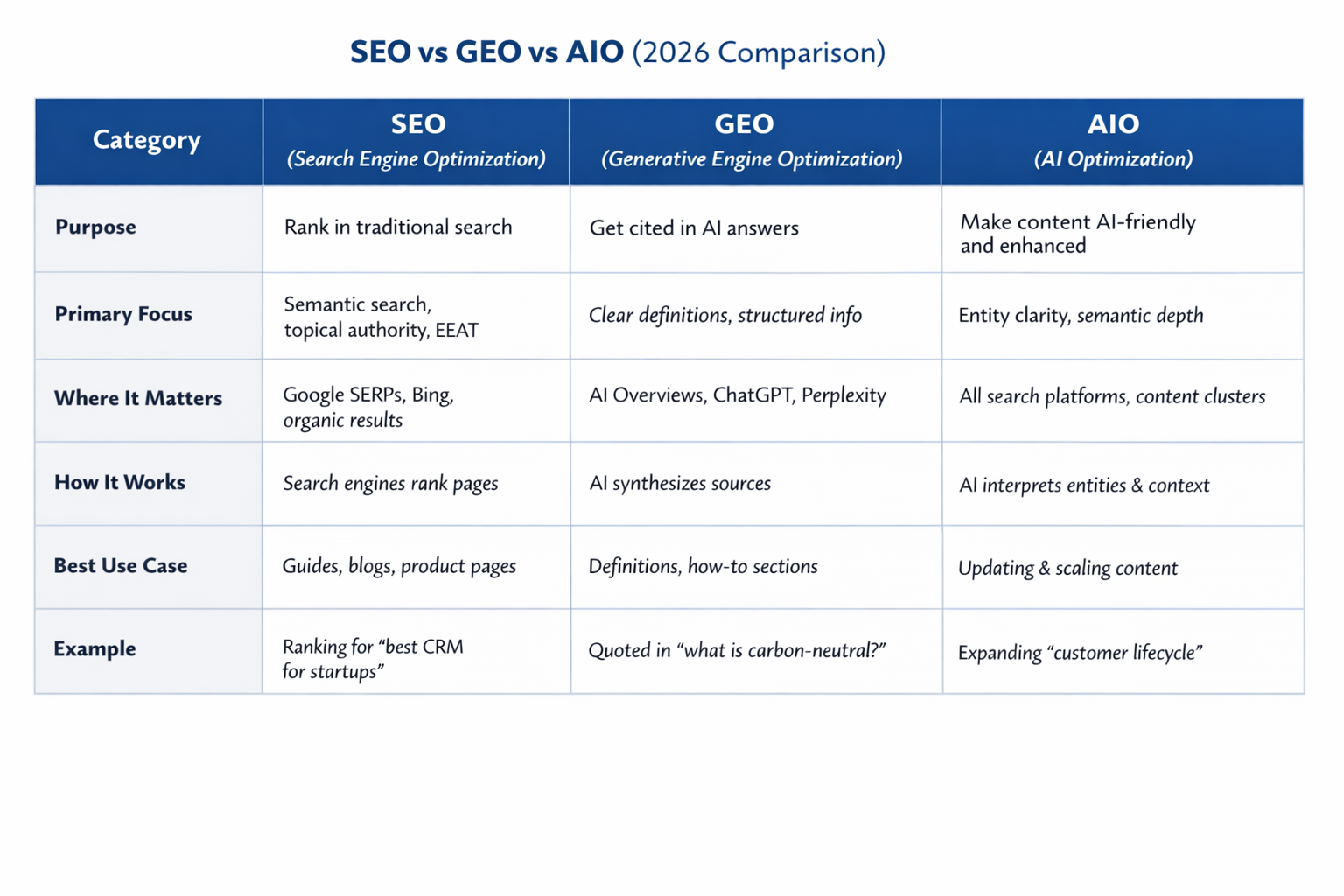
SEO, GEO, and AIO aren’t competing strategies. They’re layers of the same ecosystem. SEO helps you rank. GEO helps you get cited. AIO helps you stay relevant in AI‑driven environments. Together, they create a unified approach to visibility across both traditional search and generative search.
Think of SEO as the foundation, GEO as the amplification layer, and AIO as the intelligence layer that keeps everything aligned with how AI systems interpret content. Businesses that use all three will appear not only in search results, but also in AI summaries, recommendations, and conversational answers. This is how SEO, GEO, and AIO can be compared:
 How to Use SEO, GEO, and AIO to Optimize Your Content
Here’s the one small bullet list you requested - your 2026 optimization stack in its simplest form:
• Start with SEO to build topical authority, semantic coverage, and strong on‑page structure.
• Layer in GEO by adding clear definitions, concise explanations, and structured sections that AI can easily cite.
Everything else flows from these two principles. Once your SEO foundation is strong, GEO becomes easier because your content already has depth and clarity. And once GEO is in place, AIO/AEO helps you refine, expand, and maintain your content so it stays aligned with evolving AI search behavior.
For example, if you’re writing about “how to choose a CRM,” you’d begin with a comprehensive SEO‑friendly guide. Then you’d add GEO‑friendly elements like a crisp definition of CRM, a short summary of key features, and a clear explanation of how small businesses evaluate tools. Finally, you’d use AIO to ensure the content covers related entities - customer lifecycle, sales pipelines, automation features - and remains updated as new CRM platforms emerge.
Search is no longer a single channel. It’s a multi‑layered ecosystem where traditional SERPs, AI Overviews, and generative engines all influence how customers discover information. If your content isn’t optimized for all three, you risk becoming invisible - even if your SEO is strong.
Businesses that embrace SEO, GEO, and AIO together will appear in more AI‑generated answers, build stronger authority, and create a durable presence across every search environment. Those who don’t will slowly fade from both rankings and AI summaries.
SEO is definitely not going anywhere. Instead, it’s evolving. And GEO, AEO, and AIO are essential for the modern business. When you combine all three, you create content that ranks, gets cited, and builds long‑term authority across both search engines and AI‑driven platforms.
This is how businesses stay visible online in 2026 and beyond.
Yes, SEO remains essential - but it’s evolved. In 2026, SEO focuses on semantic search, topical authority, and user intent satisfaction. Ranking is no longer just about keywords or backlinks; it’s about whether your content fully answers the query, demonstrates expertise, and engages users meaningfully.
GEO (Generative Engine Optimization) is about making your content citable by AI systems like ChatGPT, Perplexity, and Google’s AI Overviews. Unlike SEO, which aims to rank pages, GEO ensures your content is structured and clear enough to be quoted or summarized by generative engines. Think of GEO as optimizing for visibility in AI-generated answers, not just search results.
AIO (AI Optimization) refers to two things:
1. Making your content machine-readable and entity-rich so AI systems can understand and trust it.
2. Using AI tools to create, refine, and scale content efficiently.
AIO helps ensure your brand is recognized by AI models and that your content stays fresh, structured, and aligned with evolving search behavior.
Not anymore. In 2026, AI search systems dominate user behavior. Even if you rank #1 on Google or other search engines , users may see an AI summary and never click. GEO and AIO ensure your content is included in those summaries, recommended by AI, and understood as authoritative. SEO alone won’t guarantee visibility.
To optimize for AI systems:
• Start with clear, concise answers at the top of your content.
• Use structured sections (FAQs, definitions, comparisons).
• Include schema markup and entity-rich language.
• Ensure your brand and author profiles are consistent and credible across platforms.
Yes, but they’re no longer the main drivers. AI systems now prioritize contextual relevance, depth of coverage, and entity relationships. Backlinks help build authority, but semantic clarity and helpfulness are what get you cited and recommended.
Ask yourself:
• Can an AI easily extract a definition or summary from your page?
• Is your content structured with headings, lists, and concise explanations?
• Do you cover related subtopics and entities?
• Is your brand information consistent across your site and external platforms?
If the answer is yes, you’re on the right track!